Birth Chart Patterns
What Is a Stellium in Astrology? How to Read It in Your Birth Chart
A stellium concentrates several planets in one part of a birth chart, but astrologers do not all count it the same way. Learn how to identify the pattern, read its planets, sign, house, and aspects, and use it as a grounded prompt for reflection.
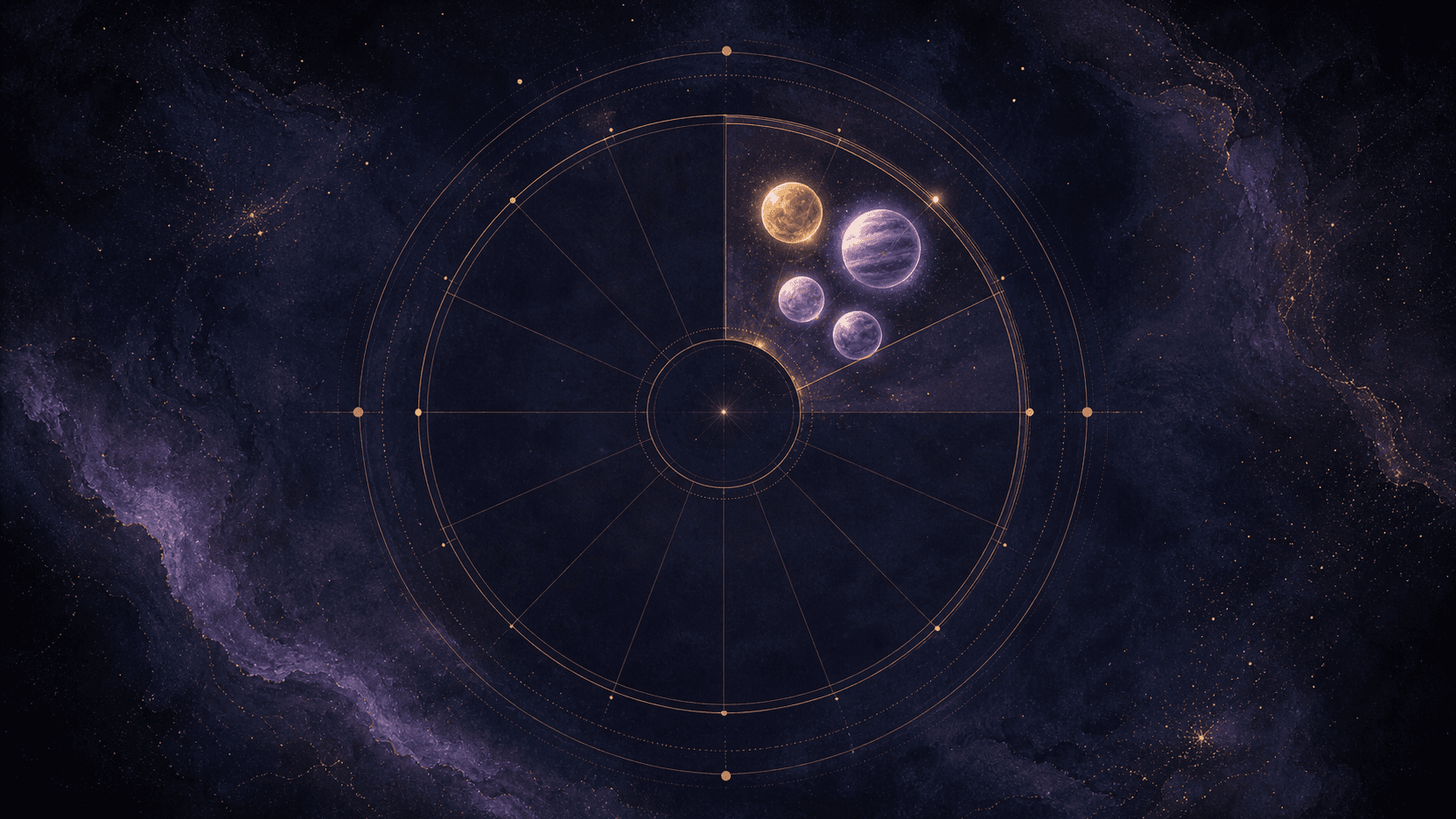
Seeing several planets crowded into one area of a birth chart can make that section feel impossible to ignore. Astrologers often call this concentration a stellium, but the label is less standardized than many quick definitions suggest. Some count three planets in one sign or house; others use stricter rules about the number of planets, their closeness, or which bodies qualify. That disagreement is not a problem to solve before you can learn from the pattern. The useful question is simpler: what happens when several chart functions are expressed through the same style, life area, or tightly connected set of themes? This guide offers a step-by-step way to explore that question while treating astrology as a reflective language rather than a scientific measurement or a fixed prediction.
What astrologers mean by a stellium
In contemporary Western astrology, a stellium generally means a noticeable concentration of planets. A common working definition is three or more planets in the same zodiac sign or the same house. A stricter astrologer may ask for four planets, require the planets to form a connected series of conjunctions, or count only certain planets. Astrodienst's Astrowiki likewise notes both the common three-planet definition and the existence of stricter views. There is no single universal counting rule across every school, so name the rule you are using instead of presenting it as settled fact.[astrodienst-stellium]
The distinction between a sign stellium and a house stellium matters. Planets in one sign share a symbolic style, even if they are spread too widely to be close conjunctions. Planets in one house share a life-area emphasis, yet they may occupy different signs when the house crosses a sign boundary. A tightly grouped set can be both. Looking at the actual degrees, not only the label produced by an app, helps you see which version is present.
You do not need to force a borderline cluster into or out of the category. If three planets sit near one another but your preferred method would not call them a stellium, you can still interpret the concentration. The label is a shortcut; the relationships among the planets are the substance.
- Write down whether the grouping is sign-based, house-based, or tightly conjunct.
- Record the planets and their exact degrees before interpreting.
- Note the counting rule your chart source or astrologer uses.
How to find a stellium in your birth chart
Start with a correctly calculated natal chart and scan the planet list. Look for three or more planets carrying the same sign name, then look around the wheel for several planetary symbols inside one numbered house. Confirm the result in the chart's table because symbols can overlap on a crowded wheel. Include the Sun and Moon if your chosen method treats them as chart planets, but keep the rule consistent from beginning to end.
House-based interpretation depends on birth time and on the house system used to calculate the chart. If your birth time is approximate or unknown, a sign concentration may still be visible, while a house stellium may be uncertain. Planets close to a house cusp can also appear in a neighboring house when a different house system is selected. Treat that as a reason to compare interpretations, not as permission to pretend that the time is exact.
Then check the degree distances between the planets. If each planet is near at least one other in the cluster, the group may function as a chain of conjunctions even when the first and last planets are farther apart. If the planets merely share a sign or house, describe that honestly. Precision makes the later reflection more useful.
- Same sign: shared style or mode of expression.
- Same house: shared area of lived experience.
- Close degrees: stronger emphasis on direct planet-to-planet interaction.
- Uncertain birth time: rely more cautiously on house placement.
Read the planets before naming the theme
Each planet represents a different function within the astrological framework. The Sun is associated with purpose and identity, the Moon with emotional needs and habits, Mercury with thinking and communication, Venus with relating and valuing, and Mars with drive and assertion. Jupiter and Saturn add themes of growth, meaning, limits, and responsibility. Uranus, Neptune, and Pluto move more slowly and are often interpreted through both personal aspects and broader generational context.
List the functions in plain language before combining them. A Mercury-Venus-Mars concentration is not one vague dose of intensity: it brings communication, relationship values, and action into the same symbolic neighborhood. Ask where those functions cooperate and where they compete. For example, direct action may interrupt diplomacy, while affection may make communication more motivating. These are prompts to test against experience, not facts the chart has proven about you.
Give extra attention to planets that closely conjoin one another or connect strongly with the rest of the chart. A planet at the edge of a wide sign grouping may participate differently from two planets only a few degrees apart. Avoid declaring one planet the leader just because it appears first in a list; use the actual contacts, sign condition, house placement, and repeated themes.
- Name each planet's function in one neutral phrase.
- Pair the functions and ask how they might cooperate.
- Pair them again and ask where their priorities might conflict.
- Keep only interpretations that connect with observable experience.
Add the sign and house as two different layers
After the planets, read the sign as the cluster's style. A fire-sign concentration may be explored through initiative and visible expression; an earth-sign concentration through practicality and tangible results; an air-sign concentration through ideas and exchange; and a water-sign concentration through feeling and sensitivity. Element language is broad, so refine it with the specific sign rather than stopping at a generic label.
Next, read the house as the setting in which the grouped functions tend to receive attention. A second-house stellium may invite reflection on resources, values, and self-support, while a seventh-house stellium may bring recurring questions about partnership and negotiation. The house does not guarantee events, professions, relationship outcomes, or levels of success. It gives you a domain in which to notice patterns.
Combine the layers in a sentence that preserves their roles: the planets describe what functions are involved, the sign describes how they operate, and the house describes where their themes are most readily noticed. If the stellium spans two signs or sits near a house boundary, write two possible sentences and compare them with real examples from your life rather than choosing whichever sounds more dramatic.
- Planets answer: what inner functions are gathered?
- Sign answers: how might those functions express themselves?
- House answers: where might the pattern receive attention?
- Experience answers: which interpretation is actually useful?
Check aspects that connect the stellium to the whole chart
A stellium can dominate your attention simply because several symbols are grouped together, but it is still part of a larger chart. Look for major aspects from planets outside the cluster. A flowing aspect may describe an easier route for expressing the concentration, while a square or opposition may point to competing needs that require adjustment. These traditional labels describe interpretive relationships, not objective measures of ease or difficulty.
Notice which stellium planet receives an outside aspect. If only one planet connects closely to another part of the chart, it may act as a bridge through which the wider cluster finds expression. Also check the planetary ruler of the stellium's sign in the interpretive system you use. Its sign, house, and aspects can add context, but it should not erase the individual planets already present.
Finally, look for balance. A chart with many placements in one area still contains planets, angles, and houses elsewhere. Concentration does not mean the rest of the chart is absent, weak, or irrelevant. It means one set of symbols may offer a particularly rich place to begin.
- Mark major aspects from outside planets to the cluster.
- Identify any planet that acts as a bridge to the rest of the chart.
- Check the sign ruler for context, not as a replacement interpretation.
- Name at least one balancing theme elsewhere in the chart.
What a stellium does not tell you
A stellium does not prove that you are destined for a particular career, relationship pattern, diagnosis, crisis, or achievement. Astrology has not been established as a scientific method for predicting personality or events. Used responsibly, the chart can supply language for reflection, help you organize questions, and draw attention to patterns you may want to observe. Decisions still require evidence, context, and your own judgment.
The pattern also does not make you more important, more gifted, or more burdened than someone without one. Many meaningful charts do not contain a stellium, and many people with one will describe it in very different ways. Slow-moving outer planets can remain near one another across many charts from the same period, so their personal relevance is usually explored through houses, close aspects, and connections with faster-moving planets rather than through rarity claims.
Be cautious with interpretations that turn concentration into inevitability. Words such as obsessive, cursed, genius, or unstoppable may sound compelling but remove nuance. Replace them with questions about attention, repetition, choice, skill, and support. If a chart reflection raises concerns about health, safety, money, or legal matters, use qualified professional guidance rather than astrology as the deciding tool.
- Do not treat concentration as destiny or diagnosis.
- Do not confuse rarity with importance or superiority.
- Do not use a chart to replace medical, legal, or financial advice.
- Do use it to form specific questions you can test in daily life.
A practical reflection exercise for your stellium
Create a four-column note labeled planets, sign, house, and evidence. Under planets, list each function in ordinary language. Under sign, write two constructive expressions and one possible overextension of that style. Under house, name the life area in concrete terms. In the evidence column, record recent situations that support, complicate, or contradict the interpretation.
Turn the pattern into one experiment for the next two weeks. If the cluster suggests that communication, relating, and action repeatedly meet in a work-related house, your experiment might be to pause before responding in one recurring collaboration and note whether the quality of the exchange changes. Keep the experiment behavioral and observable. You are not testing whether astrology is scientifically true; you are testing whether a symbolic prompt helps you notice and choose more deliberately.
At the end, revise your interpretation. Remove phrases that never connected with experience, soften claims that were too absolute, and keep observations that led to a useful choice. A good reading becomes more precise as you engage with it; it does not demand that your life conform to the chart.
- Describe the pattern without flattering or frightening language.
- Choose one observable behavior, not a predicted outcome.
- Collect examples that agree and disagree with your first reading.
- Revise the interpretation after two weeks.
Putting it together
A stellium is most useful when you treat it as a concentration to investigate, not a verdict to obey. Begin with the planets, distinguish sign from house, check the actual degrees and outside aspects, and keep uncertainty visible when birth time or definitions are unclear. Then bring the symbolism back to lived experience through a small, observable reflection exercise. Whether or not the label fits a strict rule, the careful process—describing, questioning, testing, and revising—can turn a crowded part of the chart into a clearer conversation with yourself. Continue with the planet guide, the aspects guide, and the houses guide.
Common questions
Frequently asked questions
Does a stellium have to include four planets?
Not in every astrological approach. Many astrologers use three or more planets, while others require four or apply rules about conjunctions and eligible bodies. State the rule you are using and focus on the actual planetary relationships.
Can the Sun and Moon count in a stellium?
Many contemporary astrologers count the Sun and Moon as part of a stellium, even though astronomy classifies them differently from planets. Some methods impose different rules, so consistency and transparency matter more than claiming one universal standard.
Is a stellium in a sign the same as a stellium in a house?
No. A sign stellium concentrates several planets in one style of expression, while a house stellium concentrates them in one area of life. A cluster can be both, but it can also share only a sign or only a house.
Can I identify a house stellium without an exact birth time?
You should be cautious. Houses and chart angles depend on the recorded birth time, so an uncertain time can change house placements. A same-sign concentration may still be readable, but the house layer should be treated as provisional.
Does having a stellium mean one area will control my life?
No. It can serve as a symbol of concentrated attention, but it does not erase the rest of the chart or guarantee events. Use the pattern to ask focused questions, then compare the interpretation with real experience and context.