Birth Chart Houses
What Do the 12 Houses Mean in Astrology? A Practical Guide
The twelve houses connect birth-chart placements with areas of life, from identity and resources to relationships, vocation, community, and rest. Learn a clear way to interpret them without treating the chart as fate.
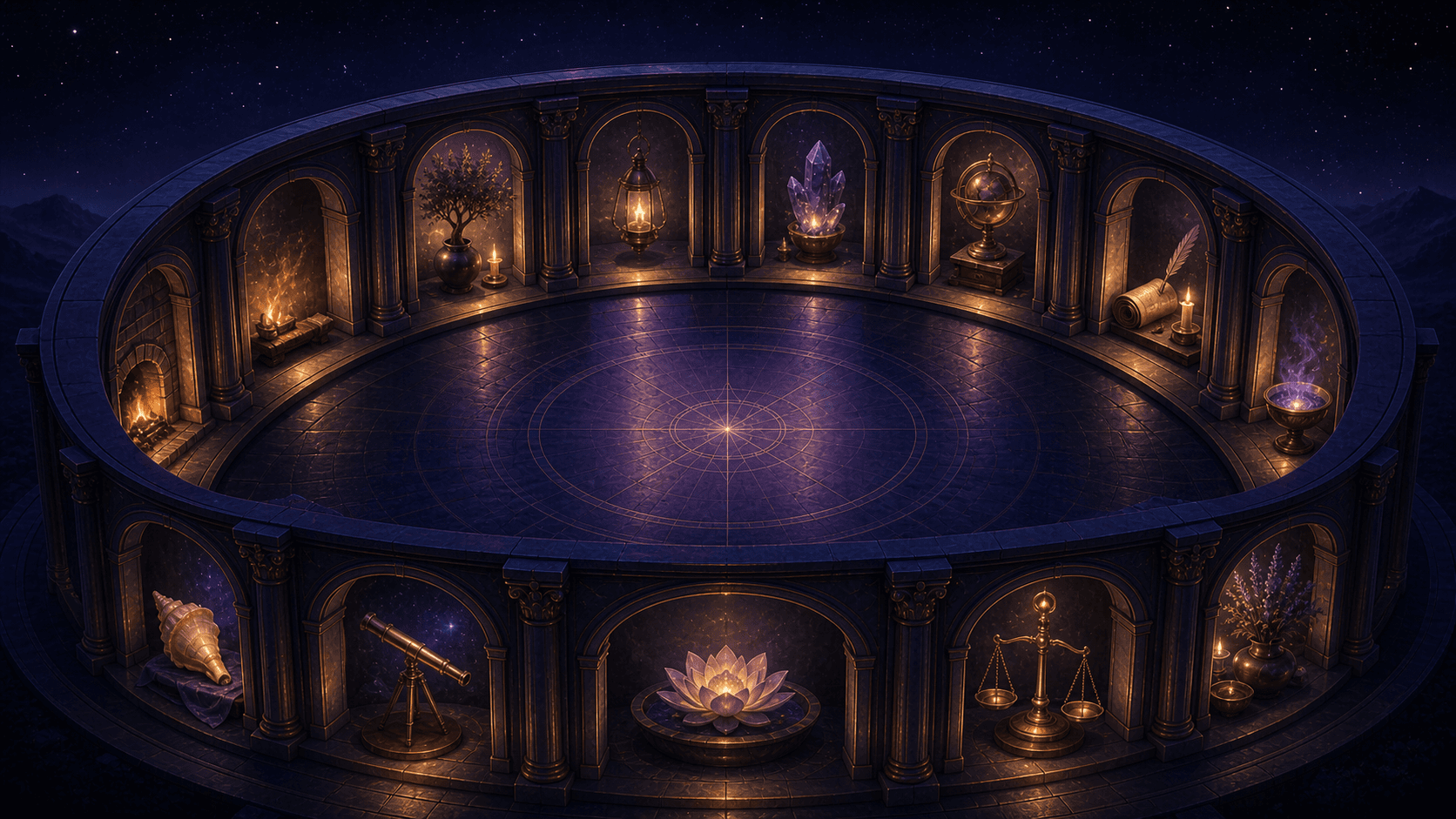
The twelve houses answer one of the most practical questions in a birth chart: where might a planet's themes become noticeable in life? A planet describes a function, its sign describes a style, and its house points to a field of experience. That makes houses useful for connecting symbols with concrete reflection. They do not divide life into twelve fixed outcomes, and they cannot guarantee events. This guide gives you a grounded meaning for every house, then shows you how to combine houses with planets, signs, and real examples from your own life.
What the houses show - and what they do not
Astrologers read houses as twelve areas of experience arranged around the chart. The first house begins from the rising side of the chart in many commonly used systems, and the houses continue in numerical order. Because the chart's local orientation depends on birth time and place, house placements are among the details most sensitive to an uncertain birth time.[usno-sidereal-time]
A house is best treated as a topic area, not a verdict. A planet in the second house may invite reflection on resources, values, or security, but it does not prove wealth or hardship. The same placement can be lived in many ways depending on the planet, sign, aspects, circumstances, choices, culture, and stage of life. Useful interpretation stays open to more than one expression and checks symbolism against lived experience.
- Planet: what function or need is active?
- Sign: how does that function tend to operate?
- House: where might it become especially noticeable?
- Aspects: how does it interact with other chart themes?
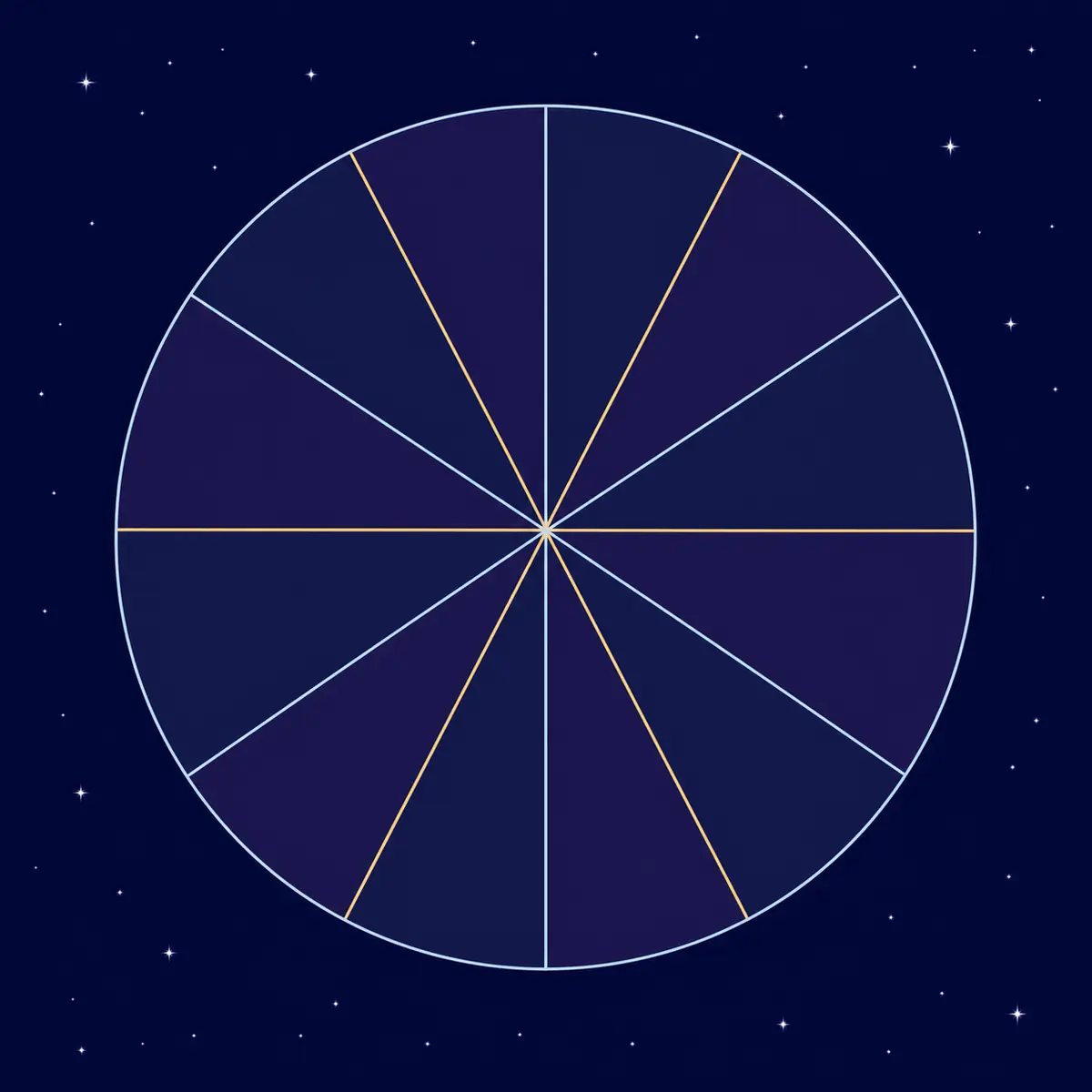
The wheel is divided into twelve houses, each describing a life area. Signs and planets add context, while the house itself identifies where a theme is being considered.
House sequence
- 1st house:
- self and approach
- 2nd house:
- resources and values
- 3rd house:
- learning and everyday communication
- 4th house:
- home and roots
- 5th house:
- creative expression and pleasure
- 6th house:
- routines and daily practice
- 7th house:
- partnership
- 8th house:
- shared stakes and change
- 9th house:
- wider meaning and exploration
- 10th house:
- public contribution
- 11th house:
- community and future hopes
- 12th house:
- retreat and inner life
Houses 1 to 3: self, resources, and everyday learning
The first house concerns how you enter situations, present yourself, and meet immediate experience. It includes the Ascendant in systems that place the Ascendant on the first-house cusp. Rather than reducing it to appearance, consider your starting posture: Do you observe first, move quickly, seek control, make contact, or adapt to the room? Planets here may become highly visible in the way you initiate and respond.
The second house concerns personal resources, material stewardship, values, skills, and the conditions that support stability. It is not a simple bank-account forecast. Reflect on what you protect, what you consider worth your effort, and how you build a workable sense of enough. The third house concerns everyday communication, learning, questions, short journeys, local surroundings, and familiar exchanges. It can describe how you gather information and make it usable in ordinary life.
- First house: approach, self-presentation, beginnings, immediate response.
- Second house: resources, values, skills, security, stewardship.
- Third house: communication, learning habits, local context, daily exchange.
Houses 4 to 6: roots, creative expression, and daily practice
The fourth house concerns home, roots, privacy, family patterns, belonging, and the inner base from which you operate. It can support questions about what feels emotionally grounding and which inherited patterns you want to keep, revise, or release. It should not be used to make confident claims about a family member or to replace the person's own account of their history.
The fifth house concerns play, creativity, pleasure, romance, risk, and forms of self-expression that carry your personal stamp. The sixth house concerns routines, work habits, service, maintenance, and the practical systems that keep daily life functioning. Although health is traditionally associated with this house, a chart cannot diagnose a condition or replace medical care. A responsible reading focuses on routines, workload, support, and sustainable practice rather than medical prediction.
- Fourth house: home, roots, privacy, belonging, inner foundation.
- Fifth house: play, creativity, pleasure, romance, personal expression.
- Sixth house: routines, work habits, service, maintenance, practical support.
Houses 7 to 9: partnership, shared stakes, and wider meaning
The seventh house concerns one-to-one relationships, agreements, cooperation, negotiation, and open conflict. It can include intimate, business, and other committed partnerships. It does not reveal a destined partner or prove compatibility. Use it to examine what you seek from an equal relationship, what you project onto others, and how you handle difference, reciprocity, and boundaries.
The eighth house concerns shared resources, trust, vulnerability, obligations, loss, inheritance themes, and experiences of deep change. Avoid sensational predictions about death, crisis, or another person's money. The ninth house concerns higher learning, belief, worldview, long-distance exploration, publishing, law as a field of inquiry, and the search for a larger frame of meaning. It can help you ask how your ideas expand and where conviction needs curiosity.
- Seventh house: partnership, agreements, reciprocity, negotiation.
- Eighth house: shared stakes, trust, vulnerability, obligations, transformation.
- Ninth house: worldview, advanced learning, exploration, meaning, perspective.
Houses 10 to 12: public contribution, community, and retreat
The tenth house concerns public role, responsibility, vocation, reputation, authority, and the contribution for which you want to be known. It is broader than a job title and cannot guarantee status or career success. A reflective reading asks what responsibility you are willing to carry, what standards guide your work, and how you want your public actions to align with your values.
The eleventh house concerns friendship, networks, groups, shared hopes, and participation in collective efforts. The twelfth house concerns retreat, solitude, endings, hidden or neglected material, compassion, imagination, and experiences that resist easy control. It is not a sentence of isolation or suffering. Read it as an invitation to notice what needs rest, privacy, closure, support, or a more compassionate kind of attention.
- Tenth house: vocation, public role, responsibility, reputation, contribution.
- Eleventh house: friendship, networks, groups, shared aims, participation.
- Twelfth house: retreat, closure, solitude, hidden patterns, compassionate attention.
How to interpret a planet in a house
Start with the planet's basic function, then place that function inside the house's topic area. Mars is often associated in astrology with effort, assertion, desire, and conflict. In the third house, those themes might appear through direct speech, energetic learning, debate, or impatience in daily exchanges. That is a range of possibilities, not a personality diagnosis. Ask which expressions you can actually observe and what helps you use the energy constructively.
Next add the planet's sign for style and its major aspects for relationships with other chart functions. Keep each layer in one sentence before combining them. If the interpretation becomes vague or dramatic, return to the four questions: what, how, where, and in relationship to what? One specific example from your life is more useful than five abstract keywords that could mean anything.
- Name the planet's function in plain language.
- Name the house topic without predicting an outcome.
- Add the sign as a style, not a separate identity label.
- Check major aspects and repeated themes elsewhere in the chart.
- Write one lived example that supports or challenges the interpretation.
How to read an empty or crowded house
An empty house does not mean that its area of life is missing. Most birth charts have several houses without planets because the chart contains more houses than the commonly used set of planets. You can still examine the sign on the house cusp and, if your approach uses house rulers, the condition and placement of that sign's ruling planet. Most importantly, you can reflect on the area through real experience instead of assuming emptiness means absence or failure.
A house containing several planets may receive more interpretive attention, but it does not automatically become the most important or difficult part of life. Separate the planets before combining them. What does each function seek in that area? Do they cooperate, compete, or describe different phases? Then compare the cluster with the rest of the chart. Concentration is a prompt to investigate, not proof that every event will revolve around one topic.
- Empty does not mean inactive, unavailable, or unimportant.
- Crowded does not automatically mean fortunate, difficult, or dominant.
- Use the same evidence-based reflective questions for both.
Why house placements can differ between charts
Astrology uses several house systems, and they do not all divide the chart in the same way. Whole Sign houses assign one complete zodiac sign to each house. Equal House uses twelve equal thirty-degree houses beginning from the Ascendant degree, while quadrant systems such as Placidus use the chart angles and additional divisions. As a result, a planet near a boundary can appear in a neighboring house when you switch systems even though the planet's zodiac position has not changed.
There is no need to hide that difference. Confirm that the birth date, time, place, time zone, and house-system setting match before comparing two charts. Then choose one system, name it, and apply it consistently while learning. If a planet changes houses between systems, compare both topic areas with concrete examples rather than selecting the interpretation that sounds most flattering. An unknown birth time makes the entire house layer uncertain, so omit confident house claims until a defensible time is available.
- Check the original birth details before interpreting a discrepancy.
- Record the house system used by each calculator.
- Keep boundary placements conditional when systems disagree.
- Treat houses as unavailable when the birth time is truly unknown.
A ten-minute method for reading your houses
Choose one planet that matters to your question rather than reading all twelve houses at once. If the question concerns communication, begin with Mercury; for relating and values, Venus; for effort and assertion, Mars. Write the planet, sign, house, and strongest aspect on separate lines. Then translate each line into everyday language without making a forecast.
Finish with observation. Write one situation where the pattern seems present, one counterexample, and one small experiment you can try. For example, if Mercury falls in the eleventh house, you might notice how your thinking changes in groups and test one clearer way to contribute in a community conversation. The chart supplies a structured question; your behavior and experience supply the evidence.
- Pick one real question and one relevant planet.
- Translate planet, sign, house, and aspect separately.
- Find one supporting example and one counterexample.
- Choose one low-stakes action to observe in daily life.
- Revise or discard the interpretation if it does not fit.
Putting it together
The twelve houses become useful when you read them as fields of experience rather than promises. Move from planet to sign to house to aspect, keep house-system and birth-time uncertainty visible, and test every interpretation against concrete life examples. A house can help you ask where a pattern deserves attention, but it does not decide what must happen. That boundary keeps astrology in a constructive role: a structured reflective practice that supports observation, choice, and revision. Continue with the birth-time guide, the planet guide, and the free Big Three calculator.
Common questions
Frequently asked questions
What is the most important house in a birth chart?
There is no single house that is most important for everyone. Start with the houses containing the Sun, Moon, chart ruler, or several planets, then focus on the house connected with your current question. Repeated themes matter more than a universal ranking.
Do empty houses mean nothing will happen there?
No. An empty house is still part of the chart and its life area still exists. It simply has no natal planet placed there. Read the cusp sign, any house ruler your method uses, current context, and your lived experience without predicting absence.
Are houses and zodiac signs the same thing?
No. Signs describe styles of expression, while houses describe areas of experience. Some teaching systems pair houses and signs as a memory aid, but they are separate layers and should not be treated as interchangeable.
Why did my planet move houses on another website?
First check that both sites use the same birth data and time-zone handling. Then compare their house-system settings. Different systems can place a planet near a boundary in neighboring houses even though its zodiac degree remains the same.
Can I interpret houses without knowing my birth time?
Not with confidence. House calculation depends on the chart's time-sensitive local orientation. You can explore stable planetary sign placements for the date, but the Ascendant, angles, and houses should remain omitted or clearly uncertain until you have a defensible time.