Birth Chart Basics
What Is a Birth Chart? A Clear Guide for Astrology Beginners
A birth chart maps the sky at the moment and place of birth. Learn what the planets, signs, houses, and aspects represent—and how to read them without getting overwhelmed.
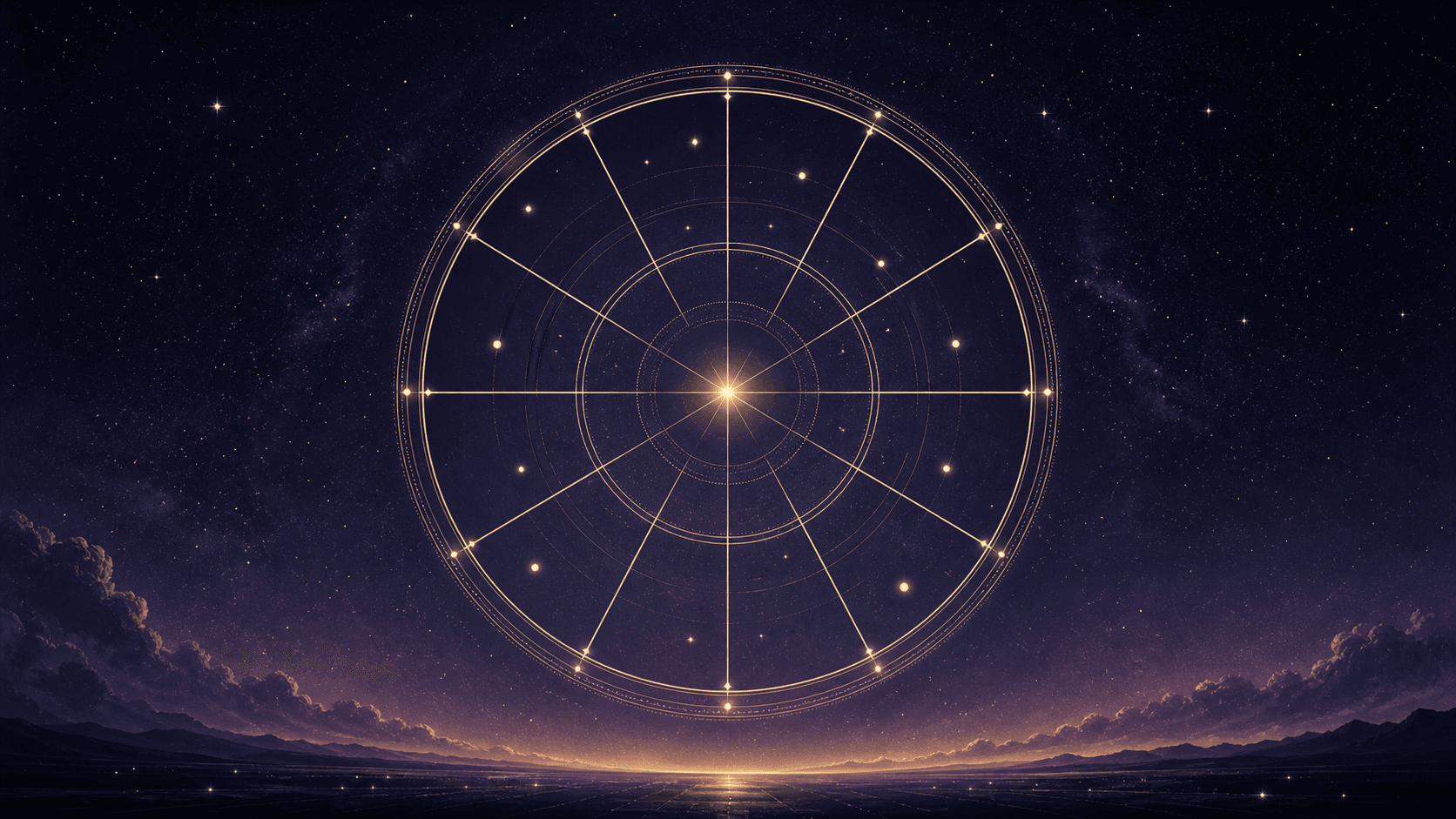
A birth chart can look like a dense wheel of symbols, lines, and numbers. Underneath that complexity is a simple idea: it is an astrological map of the sky for one date, time, and place. Learning to read it becomes much easier when you stop trying to decode everything at once and instead move through four clear layers—planets, signs, houses, and aspects.
A birth chart is a map, not a verdict
A birth chart, also called a natal chart, records where the Sun, Moon, and planets appeared along the zodiac at a particular moment. It also maps those positions against the local horizon, which is why a complete calculation asks for a birthplace as well as a birth time.[jpl-spice]
The starting positions are astronomical calculations; the meanings assigned to them are part of astrology's symbolic tradition. At Cosmic Oracle, that symbolism is used for reflection and self-understanding. A chart can offer language for patterns and questions, but it does not define your personality or dictate what must happen to you.
- The chart records a specific moment and location.
- Astrology interprets the calculated positions symbolically.
- The result is a reflective framework, not a fixed verdict.
Why the exact birth details matter
Your birth date establishes the broad planetary positions for that day. Your birth time and location establish the local horizon and orientation of the chart. Together, these details are used to calculate the rising sign and the twelve houses.[usno-sidereal-time]
Even a modest difference in recorded time can move house cusps and, near a sign boundary, can change the rising sign. If your birth time is unknown, you can still explore many planetary sign placements, but interpretations involving the Ascendant and houses should be treated as uncertain rather than quietly presented as exact.
- Date: the planetary positions for the day.
- Time: the sky's orientation relative to the local horizon.
- Place: the geographic reference used for that orientation.
The four layers that organize the chart
Most beginner confusion disappears when every placement is translated with the same four questions. The planet tells you what function is being described. The sign tells you how that function tends to express itself. The house tells you where in life it may become noticeable. Aspects show how different functions interact.
For example, Venus is associated in astrology with relating, attraction, and values. Its sign describes the style of those themes, its house points to a life area where they may receive attention, and its aspects add cooperation, tension, or emphasis from other planets. This structure is more useful than memorizing isolated slogans.
- Planet: what part of experience is active?
- Sign: how does it tend to operate?
- House: where does it show up?
- Aspect: how does it interact with the rest of the chart?
Planets describe the function
In astrological interpretation, each planet acts like a category of human experience. The Sun is associated with identity and direction; the Moon with instinctive needs and emotional regulation; Mercury with thinking and communication; Venus with values and connection; and Mars with effort, assertion, and desire.
The slower-moving planets add broader themes. Jupiter is commonly connected with growth and meaning, Saturn with structure and responsibility, Uranus with disruption and independence, Neptune with imagination and blurred boundaries, and Pluto with power and deep change. These are interpretive lenses, not diagnoses or guarantees about behavior.
Signs describe the style of expression
Western tropical astrology divides the zodiac into twelve equal signs of thirty degrees each. The zodiac follows the ecliptic, the apparent annual path of the Sun across the sky. Astrological signs are equal symbolic sections and should not be confused with the modern astronomical constellations, which have irregular boundaries and different sizes.
A sign modifies a planet rather than replacing it. Mercury in a fire sign, for example, is traditionally read differently from Mercury in an earth sign, but both placements still describe Mercury themes such as perception, language, and reasoning. Reading planet and sign together keeps the interpretation specific without turning one placement into an entire personality.
Houses describe the area of life
The houses divide the chart into twelve areas beginning at the Ascendant, the zodiac degree rising on the eastern horizon. Astrologers associate the houses with areas such as identity, resources, communication, home, creativity, work, partnership, shared commitments, belief, public life, community, and retreat.
A planet's house answers where its themes may become especially visible. Mars in a partnership house is interpreted through relationships differently from Mars in a career-oriented house. House systems calculate the intermediate cusps in different ways, so two reputable charts can occasionally place a planet in neighboring houses. The system used should be named and applied consistently.
Aspects show how the chart's parts connect
Aspects are measured angular relationships between planets. Major aspects include the conjunction, opposition, square, trine, and sextile. In traditional interpretation, some describe easier coordination while others describe friction that asks for awareness and adjustment.
No aspect is automatically good or bad. A trine may describe an ability that feels natural but goes undeveloped, while a square may describe a recurring conflict that becomes productive through practice. The most useful reading explains both the resource and the challenge instead of reducing an aspect to a prediction.
A simple order for your first reading
Begin with the Sun, Moon, and rising sign to establish the chart's broadest themes. Then read Mercury, Venus, and Mars because they describe everyday thinking, relating, and action. Add the houses for those placements, and only then examine the strongest aspects among them.
After the personal planets make sense, look for repetition. A theme supported by several placements usually deserves more attention than a single dramatic-sounding symbol. Repeated elements, signs, house areas, or aspect patterns help turn separate definitions into a coherent whole-chart reading.
- First: Sun, Moon, and rising sign.
- Second: Mercury, Venus, and Mars in their signs.
- Third: the houses occupied by those placements.
- Fourth: the strongest aspects and repeated themes.
What a birth chart cannot tell you
A responsible birth chart reading cannot guarantee future events, determine compatibility from one placement, diagnose a health condition, or replace professional medical, legal, financial, or mental health advice. It also cannot remove context, choice, culture, experience, or personal responsibility from a person's story.
The useful question is not whether a symbol proves who you are. Ask whether the interpretation helps you notice a real pattern, name a need, understand a tension, or make a more deliberate choice. Keep what leads to honest reflection, question what does not fit, and avoid surrendering decisions to the chart.
Putting it together
A birth chart becomes readable when you treat it as a layered map. Start with the planet, add the sign, place it in a house, and then connect it through aspects. Look for repeated themes and keep the interpretation grounded in your actual life. Used this way, astrology can offer structured questions for reflection without pretending to replace evidence, judgment, or choice. Continue with the twelve houses guide, the planet guide, and the free Big Three calculator.
Common questions
Frequently asked questions
Is a birth chart the same as a zodiac sign?
No. A zodiac or Sun sign is one placement in a full birth chart. The complete chart also includes the Moon, planets, rising sign, houses, and aspects calculated for a specific time and place.
Can I calculate a birth chart without an exact birth time?
You can still calculate many planetary sign positions, but the rising sign and houses may be unreliable. A responsible reading should label those parts as uncertain instead of treating a guessed time as exact.
Which part of a birth chart should a beginner read first?
Start with the Sun, Moon, and rising sign. Then add Mercury, Venus, and Mars, followed by their houses and strongest aspects. This order gives context before detail.
Why can two birth chart websites show different houses?
They may use different house systems, timezone data, or birth-time settings. Check that the underlying birth details match, then confirm which house system each chart uses before comparing interpretations.
Does a difficult aspect mean something bad will happen?
No. Challenging aspects are usually interpreted as tensions or competing needs, not guaranteed events. They can describe areas that become more workable through awareness, support, and practice.