Birth Chart Planets
What Do the Planets Mean in Astrology? A Birth Chart Guide
Planets describe different functions in an astrological birth chart, from identity and emotion to communication, desire, growth, and change. Learn what each one represents and how to combine planet, sign, house, and aspect without turning symbolism into fate.
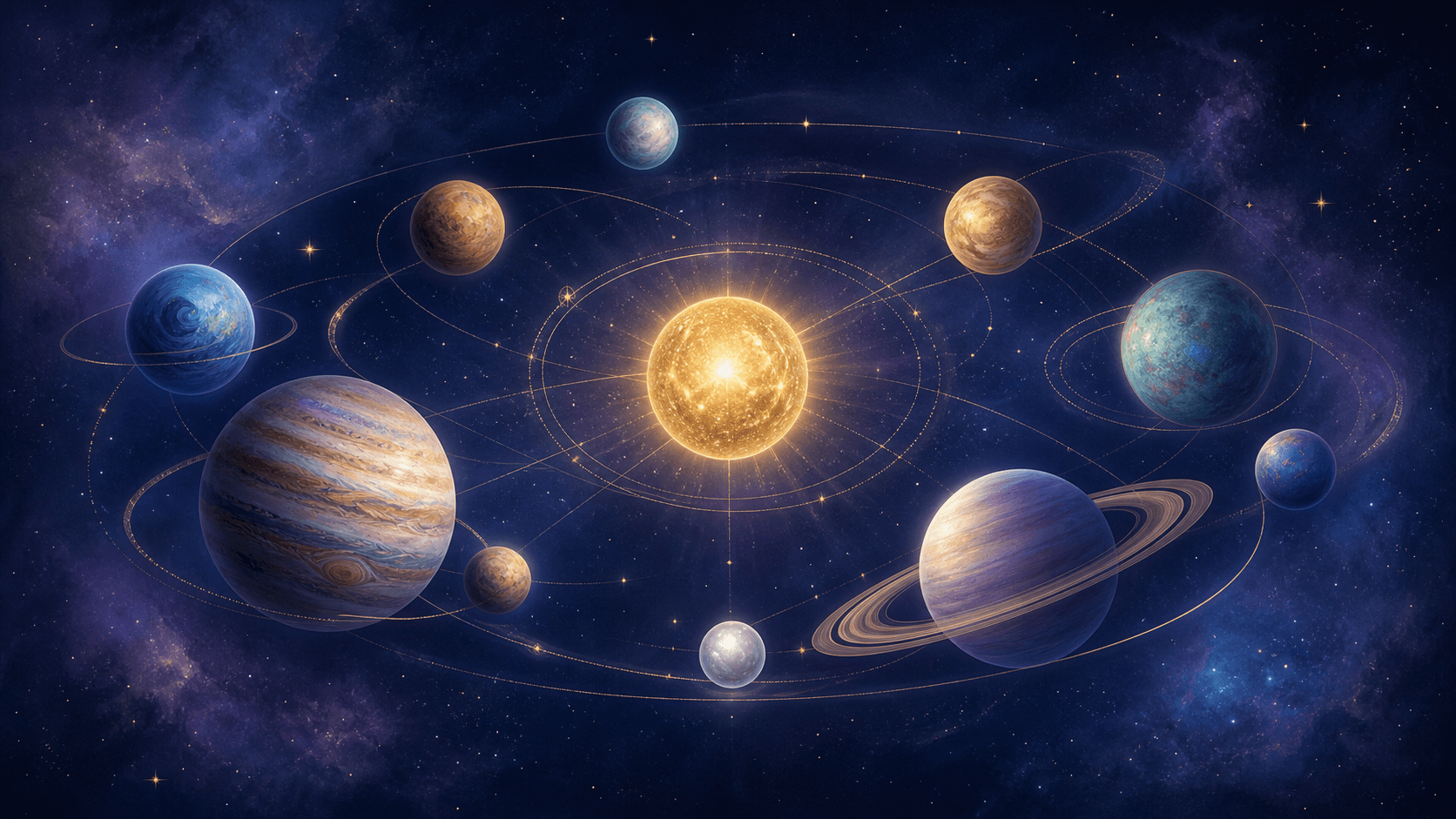
When a birth chart first opens, the symbols can look like a crowded code. A useful way in is to treat each planet as a different function within the chart: the Sun describes purposeful identity, the Moon describes instinctive needs, Mercury describes how the mind exchanges information, and so on. The planet does not deliver a verdict about personality or predict a fixed event. It gives you a question to explore. This guide explains the common meanings of the ten bodies used in modern Western astrology and shows how to combine them with signs, houses, and aspects in a grounded, reflective way.
What astrologers mean by a planet
Astrology uses the word planet as convenient shorthand for a set of chart factors. Astronomically, our solar system has eight planets, while the Sun is a star, the Moon is Earth's natural satellite, and Pluto is classified as a dwarf planet. In a typical modern Western birth chart, however, the Sun, Moon, and Pluto are interpreted alongside Mercury through Neptune because each has an established symbolic role in that tradition.[nasa-planets][nasa-sun]
That distinction matters. A birth chart is based on calculated positions in the sky for a time and place, but the meanings assigned to those positions belong to an interpretive tradition; they are not scientifically established forces that determine character or events. You can use the symbolism to notice patterns, name tensions, and generate better questions without treating it as proof, diagnosis, or destiny.
Start with a simple grammar: the planet names the function, the sign describes the style or strategy, the house points to an area of life, and the aspects show how chart factors interact. Reading in that order keeps one placement from becoming an oversized label.
- Planet: what psychological or symbolic function is active?
- Sign: how does that function tend to express itself?
- House: where in life does the theme become noticeable?
- Aspect: which other functions support, challenge, or redirect it?
The Sun and Moon: identity and inner needs
The Sun is commonly associated with vitality, direction, conscious identity, and the qualities a person is learning to embody with intention. Your Sun sign can describe what feels meaningful to develop, but it is not a complete personality summary. Its house suggests where purpose and visibility may matter, while its aspects show what makes self-expression easier, more complicated, or more nuanced.
The Moon is commonly associated with emotional rhythms, instinctive reactions, memory, comfort, and the conditions that help you feel secure enough to respond rather than merely react. The Moon can be especially useful for reflection because it asks practical questions: What restores you? What do you do automatically under pressure? Which forms of care feel nourishing, and which are simply familiar?
Read the Sun and Moon as a pair. Agreement between them does not guarantee an easy life, and tension between them is not a flaw. The pair can describe an ongoing negotiation between chosen direction and immediate needs. Naming both sides often produces a more humane interpretation than deciding that one must defeat the other.
- Sun: purpose, vitality, conscious identity, creative direction
- Moon: needs, habits, emotional rhythm, safety, responsiveness
- Reflection: What helps my intentions and my needs work together?
Mercury, Venus, and Mars: everyday personal expression
Mercury describes processes of perception, learning, language, and exchange. Rather than reducing Mercury to whether someone is a good communicator, look at how the person gathers information, organizes thoughts, asks questions, and adjusts a message for different contexts. A challenging Mercury aspect can describe complexity or effort, not a permanent inability.
Venus describes attraction, preference, reciprocity, pleasure, aesthetics, and the ways people recognize value. In relationship readings, Venus is more useful as a prompt about what feels enjoyable and mutually worthwhile than as a compatibility score. It can also speak to taste, spending priorities, creative choices, and the balance between receiving and accommodating.
Mars describes assertion, pursuit, separation, conflict, effort, and the use of energy. Its placement can help you ask how desire becomes action, how frustration is expressed, and what makes initiative sustainable. Mars is not automatically aggression, just as Venus is not automatically romance; both operate across ordinary decisions, boundaries, work, play, and relationships.
- Mercury: perceive, name, learn, connect, communicate
- Venus: value, attract, enjoy, relate, receive
- Mars: desire, initiate, defend, compete, act
Jupiter and Saturn: expansion with structure
Jupiter is commonly linked with expansion, confidence, meaning, opportunity, generosity, and the search for a wider horizon. It can show where experience grows through exploration, teaching, belief, or taking a chance. More is not always better, though. Jupiter can also invite reflection on excess, overconfidence, or promises that outpace practical capacity.
Saturn is commonly linked with limits, responsibility, time, consequence, discipline, and durable structure. It is often described too narrowly as punishment. A more useful reading asks where patience, realism, boundaries, and repeated practice are required. Saturn themes may feel demanding precisely because they expose the difference between a wish and something built to last.
Together, Jupiter and Saturn describe a valuable rhythm: growth needs room, and room needs structure. In a practical chart reading, compare where you are inclined to enlarge possibilities with where you are asked to define terms, accept constraints, or develop mastery. Neither principle is inherently lucky or unlucky.
- Jupiter: growth, perspective, faith, opportunity, excess
- Saturn: limits, commitment, accountability, patience, craft
- Reflection: Where would expansion benefit from a clearer container?
Uranus, Neptune, and Pluto: slower collective themes
Uranus, Neptune, and Pluto move slowly enough that many people born near one another share the same sign placements. Their signs therefore describe broad generational themes more readily than a unique personality trait. They become more personally distinctive through house placement, close aspects to the Sun, Moon, Mercury, Venus, Mars, or chart angles, and the life context in which the symbolism is explored.
Uranus is associated with disruption, awakening, experimentation, independence, and breaks from convention. Neptune is associated with imagination, ideals, permeability, longing, compassion, and confusion. Pluto is associated with power, compulsion, exposure, loss, regeneration, and deep change. These words describe interpretive themes, not guaranteed events or moral qualities.
Outer-planet language can become dramatic very quickly. Keep the scale proportional. Neptune does not make every uncertainty a deception, Pluto does not make every transition a catastrophe, and Uranus does not require rebellion for its own sake. Ask what is actually observable in the person's choices and circumstances before attaching an intense story to a symbol.
- Uranus: liberation, innovation, disruption, difference
- Neptune: imagination, ideals, sensitivity, ambiguity
- Pluto: power, compulsion, truth-telling, transformation
How to combine a planet, sign, house, and aspect
Build one interpretation at a time instead of collecting disconnected keywords. Suppose a chart has Mercury in a water sign, placed in a relationship-oriented house, and closely linked by aspect with Saturn. Begin with Mercury's function: thinking and communication. Add the sign as a possible style: receptive, contextual, or emotionally attuned. Add the house as the setting in which exchange becomes especially visible. Then let Saturn introduce questions about caution, responsibility, delay, precision, or fear of being misunderstood.
Notice the use of possible rather than definite. The same symbolism might appear as careful listening, a preference for serious conversations, slow trust in collaboration, disciplined writing, or hesitation before speaking. A responsible reading offers several plausible expressions and checks them against lived experience. It does not select the most dramatic version and announce it as fact.
Finish with a usable question. You might ask, 'When does careful preparation improve communication, and when does it become self-censorship?' That question preserves the chart's tension while returning agency to the person reading it.
- Name the planet's function without judging it.
- Describe the sign as a style, not a stereotype.
- Locate the house topic in real, current life.
- Use aspects to add dialogue, tension, and alternatives.
- End with a question or experiment the reader can test.
Which planets should you read first?
You do not need to interpret all ten bodies at once. For a first pass, read the Sun and Moon, then Mercury, Venus, and Mars. These five describe recognizable personal functions and give you enough material to compare intention, needs, thought, values, and action. Add Jupiter and Saturn to explore growth and responsibility. Bring in the outer planets when they are closely connected to personal planets or angles, or when their houses clearly match the question you are exploring.
Emphasis matters more than a fixed ranking. A planet near a major chart angle, involved in several close aspects, or strongly connected to the topic of the reading may deserve earlier attention. This is also where accurate birth time becomes important: the planets remain in their signs for the date, but the houses and angles can change as the recorded time changes.
If your birth time is uncertain, resist false precision. You can still explore planetary signs and many planet-to-planet aspects, while treating the Moon with appropriate timing caution when it changed signs that day. Leave houses and angles open until you have a reliable time or compare clearly labeled time ranges.
- First pass: Sun, Moon, Mercury, Venus, and Mars
- Second pass: Jupiter and Saturn
- Then: outer planets with close personal contacts or clear relevance
- Always: match the level of certainty to the birth data you actually have
A practical planet-reading routine
Choose one planet connected to a real question rather than reading the whole chart in the abstract. If the question concerns motivation, start with Mars; if it concerns communication, start with Mercury; if it concerns belonging or emotional restoration, start with the Moon. Write down the planet's sign, house, and closest major aspects, then translate each layer into plain language.
Next, collect evidence from your own experience. Look for two examples when the placement felt constructive and one when it felt difficult or overused. This prevents a single memory from becoming the entire interpretation. It also reveals that a symbol can have different expressions depending on maturity, environment, support, and choice.
Finally, design a small experiment. A Mars question might become a clearer boundary stated before frustration builds. A Mercury question might become summarizing what you heard before replying. A Saturn question might become a modest routine repeated for two weeks. The chart supplies a lens; observation tells you whether the lens is useful.
- Pick one planet that matches a current question.
- Translate its sign, house, and aspects into ordinary language.
- Gather examples that support and complicate the first interpretation.
- Try one small action and review what actually changed.
Putting it together
Planet meanings become useful when they help you ask better questions rather than collect fixed labels. Begin with the function of one planet, add its sign as a style, locate its house in lived experience, and use aspects to notice cooperation or tension. Then compare the interpretation with actual patterns and choose a small experiment. The result is not a cosmic verdict; it is a structured reflective practice that can make a complex birth chart clearer while leaving room for context, uncertainty, and personal agency. Continue with the zodiac-sign guide, the houses guide, and the aspects guide.
Common questions
Frequently asked questions
Why are the Sun and Moon called planets in astrology?
It is astrological shorthand, not an astronomy classification. Modern Western charts interpret the Sun and Moon alongside the planets because they have established symbolic roles. Astronomically, the Sun is a star and the Moon is Earth's natural satellite.
Which planet is most important in a birth chart?
There is no universally most important planet for every question. The Sun and Moon are useful starting points, while planets near major angles, involved in close aspects, or directly connected to the topic you are exploring may deserve special attention.
Do planets in astrology control personality or events?
Astrological interpretations are not scientifically established as forces that control personality or events. A responsible reading treats planetary meanings as reflective symbols that can help organize questions, compare patterns, and consider choices without claiming certainty.
What are personal, social, and outer planets?
In common modern Western terminology, the Sun, Moon, Mercury, Venus, and Mars are personal factors; Jupiter and Saturn are social planets; Uranus, Neptune, and Pluto are outer or generational planets. The groupings are interpretive conveniences, not scientific categories.
Can I read planets without knowing my exact birth time?
Yes, with limits. Planetary sign positions and many planet-to-planet aspects can still be useful, but houses and chart angles depend on time. The Moon may also need caution if it changed signs during the possible birth-time window.