Birth Chart Aspects
What Are Aspects in Astrology? A Practical Birth Chart Guide
Astrological aspects describe the angles between placements in a birth chart. Learn the five major aspects, what an orb means, and a practical method for reading them without reducing your chart to good or bad labels.
When a birth chart lists Venus square Saturn or Moon trine Jupiter, it is describing an aspect: an angular relationship between two placements on the chart's 360-degree circle. The angle is a calculation; the meaning attached to it belongs to astrological tradition, not established science. Used reflectively, aspects can help you compare two drives, needs, or habits and ask how they cooperate, compete, or require conscious coordination. This guide explains the five major aspects, the role of an orb, and a repeatable way to read an aspect without treating it as fate or sorting your chart into simplistic good and bad categories.
What an aspect actually measures
A birth chart places the Sun, Moon, planets, and calculated points at specific degrees around a circle. An aspect appears when the distance between two of those positions is close to a recognized angle. A conjunction is near 0 degrees, a sextile near 60, a square near 90, a trine near 120, and an opposition near 180. These are commonly called the five major aspects in modern Western astrology.[astrodienst-aspect]
The underlying positions come from astronomical calculations. NASA describes the ecliptic as the apparent path along which the Sun and planets seem to travel from Earth's perspective, and JPL's Horizons system produces observer-based ephemerides for solar-system objects. Astrology then adds a symbolic interpretive framework to those calculated positions. That second step is a tradition of meaning-making, not a scientifically validated method for predicting personality or events.
On a chart wheel, aspect lines make relationships visible at a glance, but the lines are not a separate force. They are a visual shorthand for angular distance. If your chart software uses colors, do not assume a red line is automatically bad or a blue line automatically good; those colors are interface conventions, not verdicts about your life.
- Angle: the approximate distance between two chart positions
- Aspect: the traditional name given to a recognized angle
- Interpretation: a reflective reading of how the two placements may relate
The five major aspects in plain language
A conjunction, near 0 degrees, places two chart factors together. Astrologers often read it as concentration or blending. The result is not automatically easy: it depends on what the two planets symbolize and how naturally those functions combine. As a reflection prompt, ask where two needs tend to arrive at the same time and may be difficult to separate.
A sextile, near 60 degrees, is traditionally associated with openings, exchange, or usable cooperation. It can be read as capacity that becomes more visible when you participate in it. Rather than expecting effortless luck, ask what skill, conversation, or experiment could help two parts of your life support each other.
A square, near 90 degrees, is commonly read as friction, pressure, or a demand for action. That does not make it a defect. Friction can reveal where two legitimate needs use incompatible strategies. Ask what recurring situation makes you choose too quickly between them, and what structure could give each need a place.
A trine, near 120 degrees, is traditionally associated with flow, familiarity, or ease. Ease can be supportive, but it can also become so automatic that you overlook it. Ask which ability feels natural enough that you underuse, overuse, or fail to name it.
An opposition, near 180 degrees, places two factors across the chart from one another. Astrologers often read it through polarity, contrast, or projection. The useful question is not which side should win, but how you can recognize both ends of the axis without assigning one entirely to another person.
- Conjunction (0°): concentration and blending
- Sextile (60°): an opening for cooperation
- Square (90°): friction that asks for a response
- Trine (120°): familiar flow or an easy capacity
- Opposition (180°): polarity, contrast, and integration
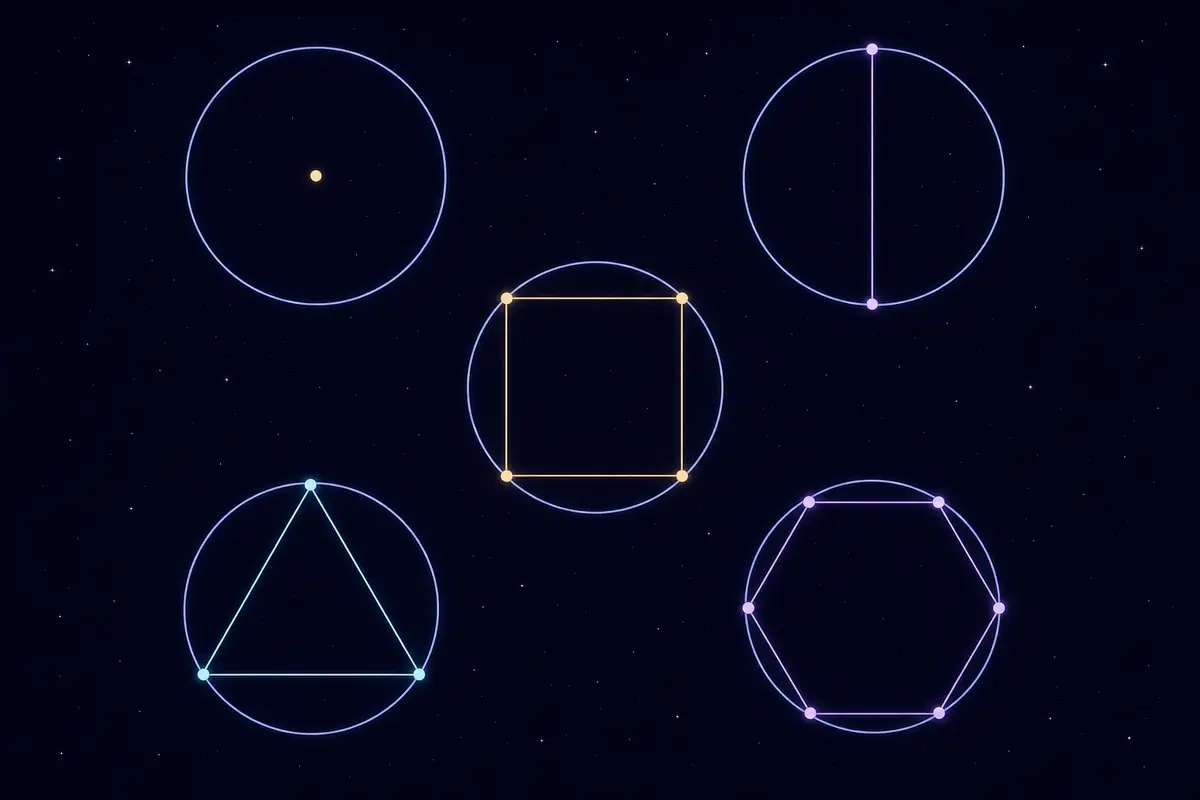
The five major aspects are ideal geometric relationships between two placements. Read the mini-diagrams as upper-left conjunction, upper-right opposition, centre square, lower-left trine, and lower-right sextile. Real chart interpretation also considers the orb, the planets involved, and the rest of the chart.
Ideal aspect angles
- Upper-left conjunction:
- 0 degrees; placements occupy nearly the same point.
- Upper-right opposition:
- 180 degrees; placements face each other across the chart.
- Centre square:
- 90 degrees; placements form a quarter-turn relationship.
- Lower-left trine:
- 120 degrees; placements form an equilateral-triangle relationship.
- Lower-right sextile:
- 60 degrees; placements form a regular-hexagon relationship.
What an orb means—and why your apps may disagree
An aspect rarely has to be exact to the minute. The allowed distance from the exact angle is called an orb. If two placements are 93 degrees apart, for example, their separation is three degrees away from an exact square. A chart tool may count that as a square if its configured orb includes the difference.
There is no single orb rule used by every astrologer or software product. Systems may allow wider orbs for the Sun and Moon, use narrower ranges for minor aspects, or change settings according to the school being followed. That variation explains why one app may display a line that another app leaves out. It does not necessarily mean either chart calculated the planetary positions incorrectly.
For a first reading, use the aspects already displayed by a trusted chart calculation and notice the orb shown beside each one. Start with the closest major aspects rather than changing settings until every possible connection appears. Exactness is one factor in prioritizing an aspect, but repetition, chart context, and relevance to the question you are exploring also matter within an astrological reading.
- Exact angle: the aspect's reference angle, such as 90° for a square
- Orb: how far the actual separation is from that exact angle
- Closer orb: less deviation from the reference angle, not proof of a real-world effect
A five-step method for reading any aspect
First, name the two placements before interpreting the line. Planets are typically treated as functions or drives: Mercury can symbolize thinking and communication, while Saturn can symbolize limits, responsibility, or structure. Keep the words provisional. You are building a useful question, not diagnosing a fixed trait.
Second, identify the aspect and translate it into a neutral relationship verb. A conjunction concentrates, a sextile connects, a square presses, a trine flows, and an opposition polarizes. Neutral verbs prevent the interpretation from collapsing into lucky versus unlucky.
Third, check the signs and houses. The signs describe the style in which each placement operates; the houses indicate the life areas where the symbolism is located in that chart system. This context makes the same aspect more specific. A Mercury-Saturn square involving learning and shared resources invites different reflection from one involving home and public responsibilities.
Fourth, write one sentence that preserves both sides: 'My need to communicate and my need for structure may create pressure around how carefully I choose words.' Fifth, test that sentence against lived experience. Look for a concrete example, a counterexample, and a choice you can make now. If the statement is vague enough to fit anything, revise it until it becomes a specific prompt—or set it aside.
- 1. Name the two placements and their possible functions
- 2. Translate the aspect into a neutral relationship verb
- 3. Add the signs and houses for style and life-area context
- 4. Write one sentence that keeps both sides visible
- 5. Compare it with experience and choose a practical reflection question
Example: reading a Moon-Mars square without fatalism
Suppose a chart shows the Moon square Mars. In common astrological vocabulary, the Moon can symbolize emotional needs, familiar reactions, and ways of seeking safety; Mars can symbolize assertion, effort, anger, or initiative. The square suggests treating those functions as a point of friction that may require active coordination. It does not establish that someone is aggressive, emotionally unstable, or destined for conflict.
A responsible synthesis might be: 'The urge to act quickly may sometimes compete with the need to feel secure or process a reaction.' Then add the signs and houses to locate the style and setting. The most useful next questions are behavioral: When does quick action protect something important? When does it interrupt emotional processing? What pause, boundary, or direct statement helps both needs receive attention?
This approach keeps the interpretation flexible enough to respect context but concrete enough to use. It also leaves room for the chart owner to disagree. An astrological symbol should never overrule a person's account of their own experience, and it should not be used to excuse harm or label another person from a distance.
How to prioritize aspects in a busy chart
A chart with many lines can feel like a puzzle that must be solved all at once. It does not. Begin with major aspects involving the Sun, Moon, rising-sign ruler, or personal planets if those are central to the question you are asking. Then notice whether one planet participates in several major aspects or whether the same theme repeats through signs, houses, and angles.
Treat an aspect pattern as a prompt to slow down, not as permission to make a more dramatic claim. A cluster of connected aspects may deserve attention because it organizes several symbols around a shared problem, but complexity does not make the interpretation more certain. Work with one relationship at a time and return to the wider pattern only after each pair is understandable.
You can also prioritize by usefulness. If an aspect gives you a precise question about a current habit, relationship dynamic, or decision process, explore it. If another produces only a generic description, leave it for later. A birth chart is more manageable when you follow meaningful threads rather than trying to honor every line equally.
- Start with close major aspects shown by your chart tool
- Notice planets that appear in several aspects
- Look for themes repeated in signs, houses, or chart angles
- Choose the aspect that produces the clearest reflective question
Common mistakes that make aspects harder to understand
The first mistake is reading a square as punishment and a trine as a reward. Both labels flatten the chart. Friction can support growth or simply describe an ongoing negotiation; ease can become a resource or an unexamined habit. Describe the relationship before judging it.
The second mistake is interpreting the aspect without the planets. 'You have an opposition' says almost nothing. The aspect tells you the kind of relationship; the two placements tell you what is relating. Signs and houses then add style and context. Keep that order so a memorized keyword does not replace synthesis.
The third mistake is treating an interpretation as evidence about health, compatibility, morality, career outcomes, or future events. Astrology has not been established as a scientific predictive method. Use it to generate questions, language, and possibilities, then rely on observation, conversation, qualified professional advice, and real-world evidence for consequential decisions.
- Do not equate challenging with bad or flowing with good
- Do not interpret the angle without naming both placements
- Do not mistake software color coding for meaning
- Do not use an aspect to diagnose, guarantee, or predict
Putting it together
Aspects become easier to read when you stop treating chart lines as verdicts and start treating them as relationships. Identify the two placements, translate the angle into a neutral verb, add sign and house context, and test the result against lived experience. Begin with one close major aspect and write a question that keeps both sides visible. The value is not in claiming certainty; it is in creating a structured moment of reflection that can lead to a clearer, more deliberate choice. Continue with the planet guide, the stellium guide, and the birth-chart overview.
Common questions
Frequently asked questions
What are the most important aspects in astrology?
Beginners usually start with the five major aspects: conjunction, sextile, square, trine, and opposition. Within a particular chart, prioritize close aspects, repeated themes, and connections that are genuinely relevant to the question you are exploring.
Are squares and oppositions always negative?
No. Astrological tradition associates them with friction or polarity, but those are interpretive descriptions rather than negative verdicts. They can be used to examine competing needs, recurring pressure, boundaries, and ways to coordinate two legitimate parts of experience.
Why does one birth chart app show more aspects than another?
Apps can use different orb limits, include different minor aspects, or apply different rules to planets and chart points. Compare the underlying birth data and positions first, then check each app's aspect settings before assuming the calculations conflict.
Should I read aspects before signs and houses?
Learn the basic roles of planets, signs, and houses first, then use aspects to connect them. For each aspect, name the two planets, identify the relationship suggested by the angle, and add the signs and houses to make the reflection specific.
Can an aspect predict what will happen to me?
An aspect does not provide a scientifically established prediction or guarantee. Cosmic Oracle presents astrology as a reflective practice: use the symbolism to form questions and notice patterns, while making important decisions from evidence, circumstances, and appropriate professional guidance.